Facts & figures
Seven years, told through the numbers.
From 2018 to 2025 — patients treated, children taught, women trained. The dips are COVID and our funding crisis. We're not hiding them.
From 2018 to 2025 — patients treated, children taught, women trained. The dips are COVID and our funding crisis. We're not hiding them.
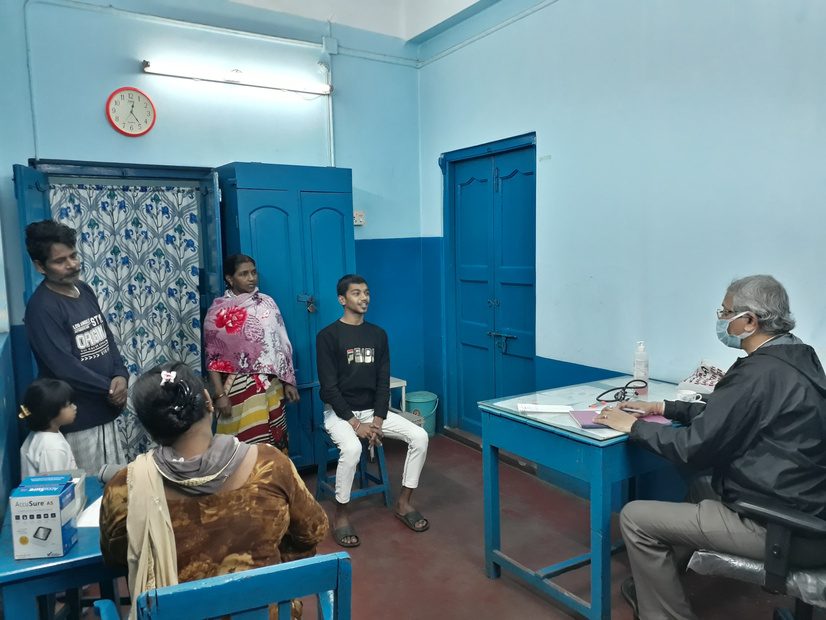
Nine free departments — general medicine, gynaecology, chest, paediatrics, dental, eye, optometry, skin and physiotherapy — serving Pilkhana and the surrounding slums. 2023–24 is a partial year: the centre was shut for seven months while our FCRA bank account was frozen, so the bar reflects only December–March.
2024–25 sits at roughly a quarter of pre-crisis volumes — consistent with our Secretary's note that we're back to "not even twenty five to thirty percent of work we did in last few years."
Skin and dental remain our highest-volume departments. Gynaecology and ENT are currently paused.
| Department | 2018–19 | 2019–20 | 2020–21 | 2022–23 | 2024–25 |
|---|---|---|---|---|---|
| General Medicine | 9,415 | 9,679 | 3,810 | 7,452 | 1,208 |
| Chest / Pneumology | 1,610 | 2,103 | 1,650 | 2,060 | 724 |
| Gynaecology | 1,241 | 1,329 | — | 465 | — |
| Paediatrics | 2,530 | 2,388 | 973 | 1,950 | 287 |
| Dental | 2,368 | 2,740 | 1,448 | 3,092 | 1,225 |
| Eye / Optometry | 1,656 | 1,759 | 1,278 | 1,708 | 626 |
| ENT | 1,005 | 1,151 | 794 | 1,101 | — |
| Skin | 2,883 | 4,148 | 3,230 | 4,164 | 1,506 |
| Physiotherapy | 3,420 | — | 1,092 | 2,566 | 860 |
2019–20 physiotherapy was reported as a breakdown of procedures (traction, electrotherapy, yoga) rather than patient visits in the original report, so it's omitted here to keep the comparison honest.
Two free primary schools — one in Banipur, one in the Sundarbans at Jharkhali. Enrolment has stayed remarkably stable even through the years our other programmes were disrupted, a testament to teachers who kept classes running without pay during the 2023–24 funding freeze.
Jharkhali's school sits within our cyclone shelter complex and historically runs roughly twice the enrolment of Baniniketan, which serves a smaller, more urban catchment in Banipur.
Bengali, English and other subject coaching for children from the slums — most of whom speak Hindi or Urdu at home and need extra support with the Bengali medium.
The programme grew enormously between the 2018–19 report (an informal class of 15–20 students) and 2024–25, when it formally expanded to cover Bengali, English and other subjects across all class groups — reaching 1,152 student-enrolments for the year.
Participation dropped during COVID, recovered strongly in 2019 and 2021, and has settled lower since — tracking closely with the wider funding pressure on the organisation.
Note: the session reported as "2020" ran April 2020–March 2021; the centre closed entirely from March to December 2020 under lockdown and resumed in January 2021.
Ricket Home treats malnourished infants aged 4 months to 2 years; once stabilised, children move on to the Crèche for pre-school care. Both closed for most of 2023–24 during the funding freeze, alongside the wider Medical Centre.
Ricket Home and Crèche attendance weren't tracked as separate child-day figures in the 2018–19 or 2022–23 reports, so those years are omitted here rather than estimated.
A small free dispensary serving Banipur and nearby villages — remarkably, it never closed during the pandemic, when most private clinics shut their doors.
Unlike the main Medical Centre, the Banipur dispensary ran continuously even through 2023–24's bank account freeze and remained open throughout the COVID lockdowns — one doctor, one nurse, one pharmacist, three days a week.
Every chart above has a year where funding determined how many children, mothers and patients we could reach.